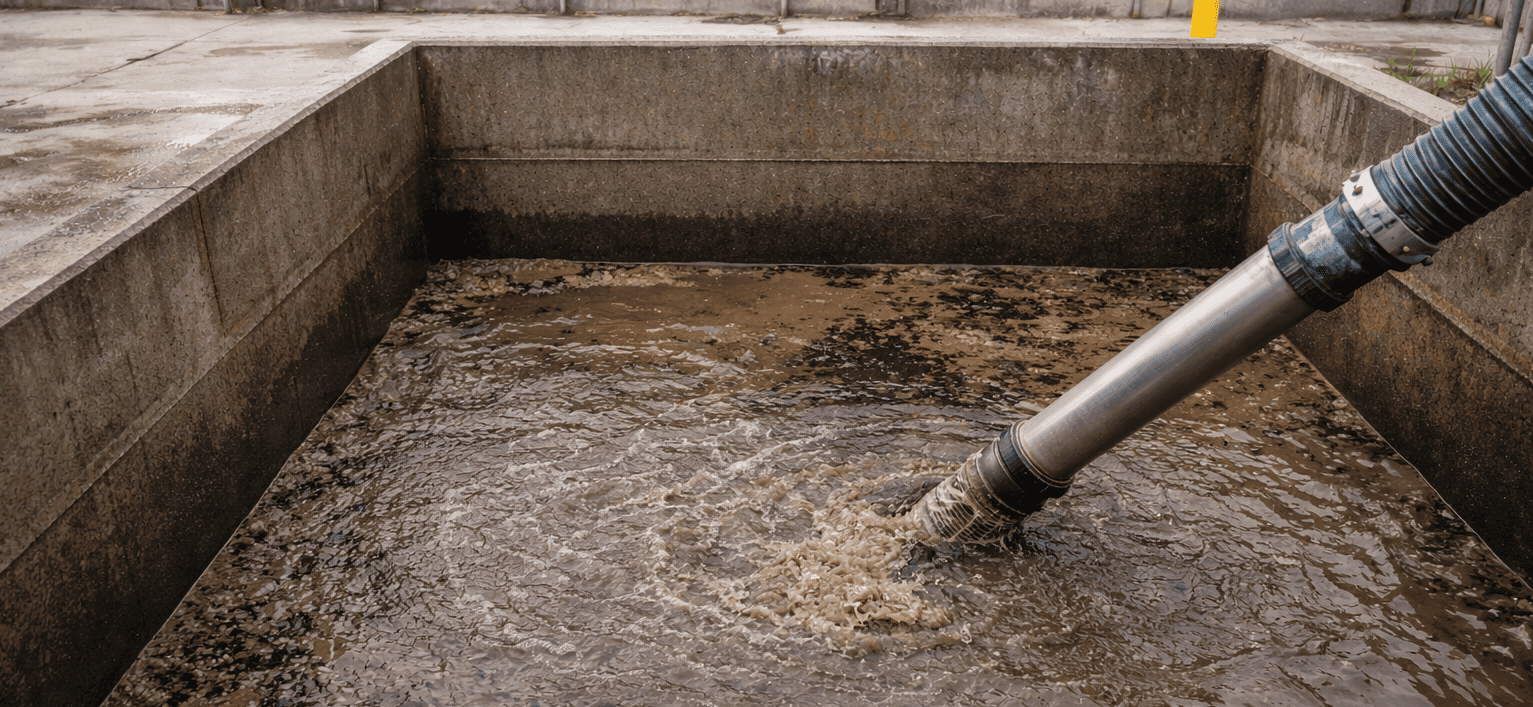
Grit traps are common at facilities where runoff carries sediment. They are also found at wash bays and areas with frequent tracking of dirt and sand. Routine grit trap cleaning helps prevent backups and protects pipes, pumps, and downstream structures.
Our Grit Trap Cleaning Process
Clean Basins follows a consistent process for grit trap cleaning. The objective is to remove settled solids and leave the trap ready to capture debris again.
- Locate and access the trap, then confirm safe working conditions.
- Inspect the structure to assess material volume and identify restrictions.
- Remove sand and solids using professional vacuum equipment.
- Rinse and wash down the interior to clear remaining fines.
- Clear inlet and outlet areas and confirm improved flow through the trap.
- Haul and dispose of removed material properly, with documentation when requested.
- Provide service notes and recommend a schedule based on site conditions.
For high-traffic sites, we can schedule service during off-peak hours. This reduces disruption for customers and staff.
Grit Trap Cleaning - Call 866-504-0761
Who We Serve
Grit traps are used in many settings. Clean Basins provides grit trap cleaning services for:
- Commercial properties with parking lots and drainage systems that collect sand and debris
- Industrial facilities with heavy sediment loads and washdown areas
- Municipal and public works sites with sediment-prone drainage structures
- Contractors who need cleanup after construction, grading, or paving
If you manage multiple facilities, we can standardize service intervals across the area. Predictable maintenance reduces emergency backups and helps keep systems consistent.
-
Joe D., Property Manager
We manage several commercial properties and use clean basins for routine catch basin and storm drain cleaning. They show up when scheduled, work efficiently, and leave the site clean. Communication ha...
-
Mike A., Municipal Maintenance
After heavy rain, we had standing water that wouldn’t drain. Clean basins responded quickly and cleared multiple storm drains in one visit. Drainage improved immediately.
Equipment Designed for Sand, Grit, and Slurry
Grit trap contents are often dense and waterlogged. Sand can compact into a heavy layer that is difficult to remove with basic tools. Clean Basins uses vactor/vacuum truck cleaning and hydrovac-assisted cleaning to remove solids and slurry efficiently.
This equipment supports controlled removal and helps keep the surrounding area cleaner. Vactor/vacuum truck cleaning is especially effective for pulling heavy sand and sediment out of below-grade traps. When wash-down is needed, the same approach helps capture loosened fines so they do not resettle downstream. Hydrovac-assisted cleaning can also be useful when a trap has tight access or requires more precise removal around internal features.
For properties, professional equipment makes it easier to restore capacity in a single visit and reduce repeat clogs.
Disposal, Compliance, and Documentation
Material removed from grit traps may include sand, sediment, organic debris, and site runoff residue. We handle collected material responsibly and dispose of it appropriately. We can provide service records and disposal documentation when requested. Many facilities use this documentation for maintenance tracking and internal compliance.